If you’re still giving all conversion credit to the last ad a customer clicked, you’re flying blind. I’ve implemented attribution models for over a dozen SaaS companies, and I can tell you: multi-touch attribution changes everything about how you allocate budget.
Here’s the reality: B2B buyers now interact with 27+ touchpoints before converting, according to Forrester Research. That means your first-touch or last-touch model is ignoring 25+ interactions that influenced the sale.
In this guide, I’ll break down exactly how multi-touch attribution works, which model fits your business, and how to implement it without the common mistakes I see teams make.
What is Multi-Touch Attribution?
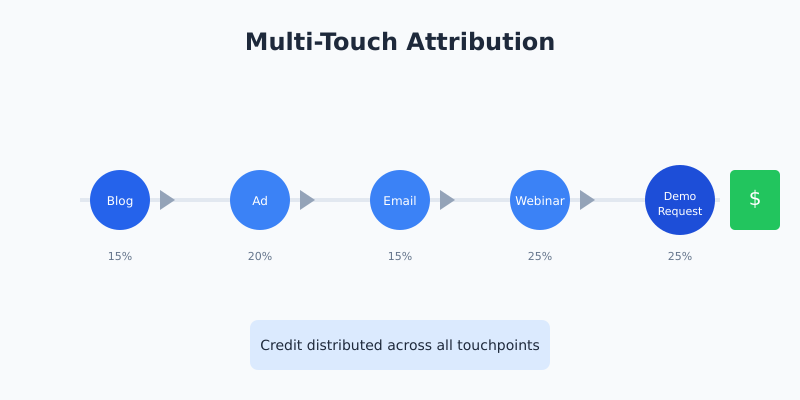
Multi-touch attribution (MTA) is a measurement approach that assigns conversion credit to multiple marketing touchpoints along the customer journey — not just the first or last interaction.
Think of it this way: if a customer discovers your product through a blog post, clicks a retargeting ad, opens three emails, and finally converts after a webinar, multi-touch attribution gives credit to all five touchpoints. The amount of credit each gets depends on which model you choose.
This matters because marketing doesn’t work in isolation. That blog post planted a seed. The retargeting ad kept you top of mind. The emails built trust. The webinar closed the deal. Single-touch models miss this entirely.
Why Multi-Touch Attribution Matters in 2026
The data is clear: companies using multi-touch attribution make better decisions.
According to HubSpot’s Attribution Report, businesses implementing MTA see:
- 37% more accurate ROI measurement
- 24% better budget allocation
- 75% of companies now use some form of multi-touch attribution
I’ve seen this firsthand. One e-commerce client was pouring budget into paid search because last-click showed it driving 60% of conversions. When we implemented time-decay attribution, we discovered that display ads were initiating 40% of those journeys. They were about to cut display entirely — that would have been a $200K mistake.
Single-Touch vs Multi-Touch Attribution
Before diving into MTA models, let’s clarify what you’re moving away from.
Single-Touch Models
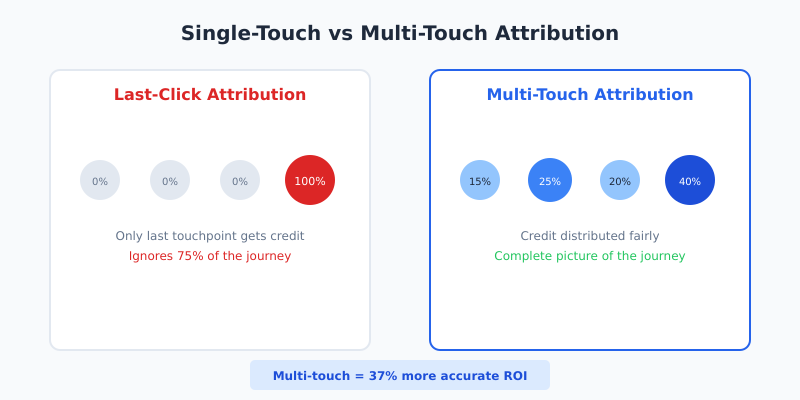
First-touch attribution gives 100% credit to the first interaction. Good for understanding awareness channels, but ignores everything that happened after.
Last-touch attribution gives 100% credit to the final interaction before conversion. Still used by 67% of B2B teams — and it’s dangerously misleading. It over-credits bottom-funnel tactics and under-credits the content and ads that started the journey.
For a deep dive on when these simpler models make sense, see our first-touch vs last-touch attribution guide.
Multi-Touch Models
Multi-touch attribution distributes credit across all touchpoints. The distribution method varies by model — and choosing the right one matters.
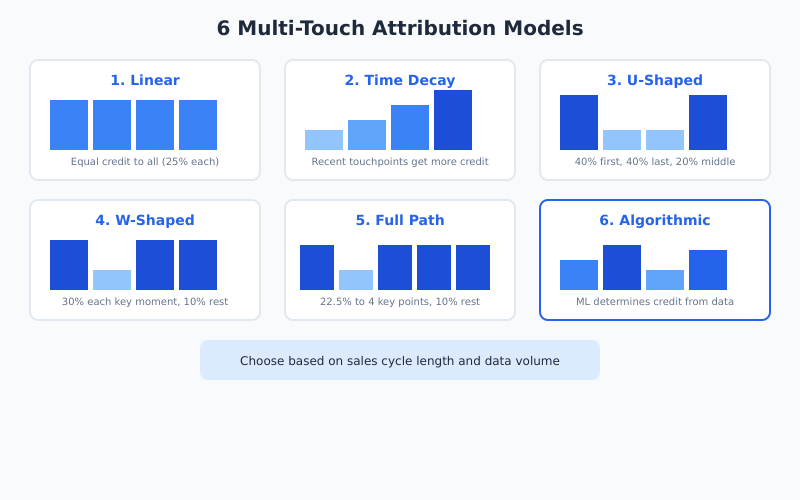
The 6 Multi-Touch Attribution Models
Here’s where most guides get too theoretical. I’ll explain each model with practical guidance on when to use it.
1. Linear Attribution
How it works: Credit is split equally across all touchpoints. Five touchpoints? Each gets 20%.
Best for: Short sales cycles (under 30 days) with 3-5 touchpoints. Works well for e-commerce and low-consideration purchases.
Limitation: Treats a casual blog visit the same as a high-intent demo request. In complex B2B sales, this oversimplifies reality.
2. Time-Decay Attribution
How it works: Recent touchpoints get more credit than earlier ones. That blog post from three months ago gets minimal credit; yesterday’s retargeting ad gets maximum credit.
Best for: Long sales cycles where recent interactions genuinely matter more. Common in B2B SaaS with 60-90 day cycles.
Limitation: Can undervalue top-of-funnel content that started the entire journey.
3. U-Shaped (Position-Based) Attribution
How it works: 40% credit to first touch, 40% to lead conversion touch, 20% distributed among middle interactions.
Best for: Lead generation businesses that care about both awareness (first touch) and lead capture (conversion touch).
Limitation: Arbitrary weighting. Why 40/40/20? It’s a useful heuristic, not a scientific measurement.
4. W-Shaped Attribution
How it works: 30% to first touch, 30% to lead creation, 30% to opportunity creation, 10% distributed among other touchpoints.
Best for: B2B companies with distinct funnel stages (lead → MQL → opportunity). Aligns attribution with your actual sales process.
Limitation: Requires clear stage definitions and proper CRM integration to identify these moments.
5. Full-Path Attribution
How it works: Extends W-shaped to include the customer close. 22.5% each to first touch, lead creation, opportunity creation, and close. Remaining 10% distributed across other touchpoints.
Best for: Enterprise sales with long cycles and multiple stakeholders. Gives visibility into what closes deals, not just what generates leads.
Limitation: Complex to implement. Requires tight marketing-sales integration.
6. Algorithmic (Data-Driven) Attribution
How it works: Machine learning analyzes your actual conversion data to determine credit distribution. No arbitrary rules — the algorithm finds patterns in your specific customer journeys.
Best for: Companies with high conversion volume (1,000+ conversions/month) and clean data. Gartner research shows algorithmic models deliver 15-25% more accurate ROI measurement than rule-based alternatives.
Limitation: Needs significant data volume. If you have 50 conversions per month, there’s not enough signal for the algorithm to learn from.
How to Choose the Right Attribution Model
Here’s my decision framework after implementing attribution for 15+ companies:
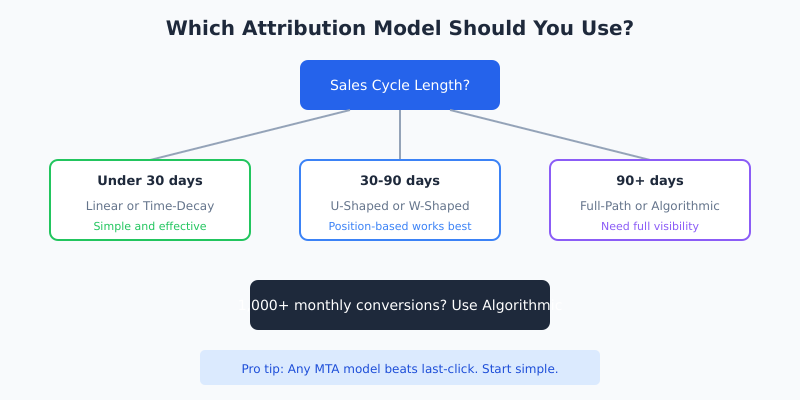
If your sales cycle is under 30 days: Start with linear or time-decay. Simple, easy to explain to stakeholders, and usually accurate enough.
If you’re B2B with a 30-90 day cycle: U-shaped or W-shaped works well. The position-based approach respects the importance of key conversion moments.
If you’re enterprise B2B with 90+ day cycles: Full-path or algorithmic. You need visibility into the entire journey, including what influences the close.
If you have 1,000+ monthly conversions: Algorithmic attribution is worth the investment. The data volume makes ML models genuinely useful.
Pro tip: Don’t overthink your first model. The jump from last-click to any multi-touch model delivers 80% of the insight. You can optimize the model later.
Implementing Multi-Touch Attribution: Step-by-Step
Here’s the implementation process I use with clients:
Step 1: Audit Your Current Tracking
Before choosing a model, ensure you’re capturing touchpoints correctly. Check:
- UTM parameters on all campaigns
- Consistent naming conventions across channels
- First-party cookies for cross-session tracking
- CRM integration for offline touchpoints (calls, meetings)
Step 2: Define Your Conversion Events
What counts as a conversion? Be specific:
- Lead form submission
- Demo request
- Trial signup
- Purchase
For B2B, you’ll likely want to attribute to multiple conversion points (lead, opportunity, close).
Step 3: Select Your Attribution Tool
Your tool choice depends on your stack and budget. Options range from free (GA4’s data-driven attribution) to enterprise platforms ($50K+/year). See our guide to marketing attribution tools for SaaS for specific recommendations.
Step 4: Run Parallel Models
Don’t switch attribution overnight. Run your new model alongside last-click for 60-90 days. Compare insights, build stakeholder buy-in, and validate the data.
Step 5: Act on the Insights
Attribution is worthless if you don’t change behavior. Review monthly:
- Which channels are over/under-credited vs. last-click?
- Where should budget shift?
- Which content assists conversions but gets no direct credit?
Common Multi-Touch Attribution Mistakes
I’ve seen these errors derail attribution projects repeatedly:
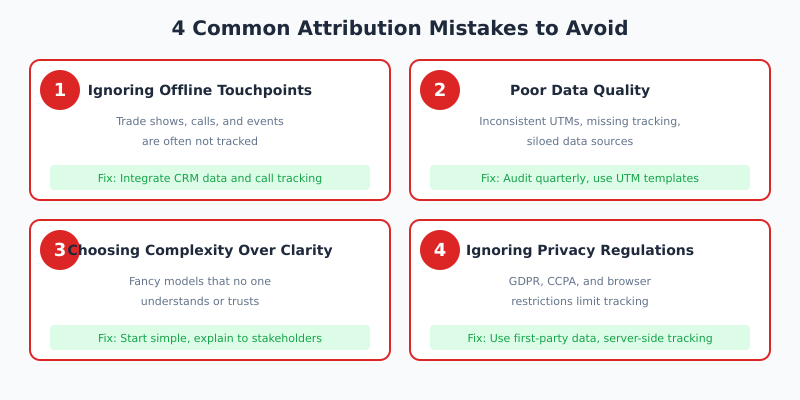
Mistake 1: Ignoring Offline Touchpoints
MTA typically tracks digital interactions. But what about trade shows, phone calls, and direct mail? If 30% of your pipeline comes from events, your attribution model is missing critical data.
Solution: Integrate CRM data. Log offline touchpoints manually or use call tracking software.
Mistake 2: Poor Data Quality
Garbage in, garbage out. Inconsistent UTM parameters, missing tracking, and siloed data make attribution unreliable.
Solution: Audit tracking quarterly. Create UTM templates. Use a CDP to unify customer data.
Mistake 3: Choosing Complexity Over Clarity
A fancy algorithmic model means nothing if your CMO can’t understand or trust it.
Solution: Start simple. Linear or time-decay attribution is easy to explain and still far better than last-click.
Mistake 4: Ignoring Privacy Regulations
GDPR, CCPA, and browser restrictions (Safari ITP, Firefox ETP) limit cross-site tracking. Cookie-based attribution is getting harder.
Solution: Invest in first-party data collection. Use server-side tracking. Consider privacy-friendly alternatives like GA4’s consent mode.
Top Multi-Touch Attribution Tools
Here are the tools I recommend based on company size and budget:
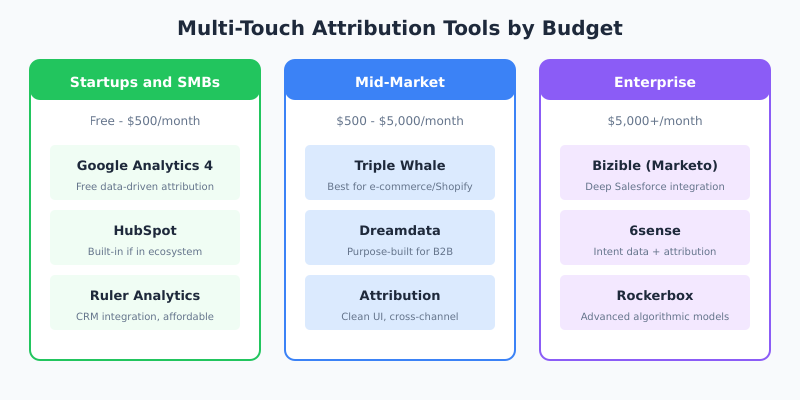
For Startups and SMBs (Free – $500/month)
- Google Analytics 4 — Free data-driven attribution, decent for basic needs
- HubSpot — Built-in attribution if you’re already in their ecosystem
- Ruler Analytics — Affordable option with CRM integration
For Mid-Market ($500 – $5,000/month)
- Triple Whale — Strong for e-commerce, especially Shopify
- Dreamdata — Purpose-built for B2B attribution
- Attribution — Clean UI, good cross-channel visibility
For Enterprise ($5,000+/month)
- Bizible (Marketo) — Deep Salesforce integration
- 6sense — Combines intent data with attribution
- Rockerbox — Advanced algorithmic models, great support
The Future of Attribution: What’s Changing
Attribution is evolving rapidly. Here’s what I’m watching:
Privacy-first measurement: As third-party cookies disappear, expect more reliance on first-party data, server-side tracking, and probabilistic modeling.
Unified measurement: The best teams combine MTA with Marketing Mix Modeling (MMM) for both tactical and strategic insights.
AI-powered attribution: Machine learning models are getting better at handling sparse data and cross-device journeys.
FAQ
What is the best multi-touch attribution model?
There’s no universal “best” model. For most B2B companies, U-shaped or W-shaped attribution works well because it emphasizes key conversion moments. For e-commerce with short sales cycles, linear or time-decay is often sufficient. If you have 1,000+ monthly conversions, algorithmic attribution delivers the most accurate insights.
How is multi-touch attribution different from last-click?
Last-click gives 100% credit to the final touchpoint before conversion. Multi-touch attribution distributes credit across all touchpoints in the customer journey. This provides a more complete picture of which channels and campaigns actually influence conversions, not just which one happens to be last.
Does GA4 support multi-touch attribution?
Yes. GA4 includes data-driven attribution as its default model, which uses machine learning to distribute conversion credit based on your actual data. It’s a significant upgrade from Universal Analytics, which defaulted to last-click. However, GA4’s attribution works best with sufficient conversion volume.
How much does multi-touch attribution software cost?
Costs range widely. GA4’s attribution is free. Mid-market tools like Triple Whale or Dreamdata run $500-$5,000/month. Enterprise platforms like Bizible or 6sense cost $5,000-$50,000+/month. The right investment depends on your marketing spend — if you’re managing $1M+ in ad budget, sophisticated attribution pays for itself.
What data do I need for multi-touch attribution?
At minimum, you need: consistent UTM tracking across all campaigns, a way to identify users across sessions (first-party cookies or user IDs), defined conversion events, and ideally CRM integration to connect marketing touches to revenue. Poor data quality is the number one reason attribution projects fail.
Key Takeaways
Multi-touch attribution isn’t optional anymore — not when your customers interact with 27+ touchpoints before buying.
Here’s what to do next:
- Audit your current tracking — Fix UTM inconsistencies and data gaps first
- Start simple — Linear or time-decay beats last-click. Don’t overcomplicate.
- Run models in parallel — Compare insights before switching entirely
- Act on the data — Attribution is worthless if it doesn’t change budget allocation
The companies winning at marketing measurement aren’t using the fanciest models. They’re using models they understand, trust, and act on. Start there, and optimize over time.

Leave a Reply