
Most B2B SaaS marketers are calculating ROI wrong. They plug numbers into the standard formula, get a result, and make budget decisions that quietly destroy long-term growth.
I have seen this play out dozens of times over the past decade working with SaaS companies on their analytics. A content marketing program gets killed because it shows negative ROI after six months. A paid search campaign gets doubled because it looks profitable in Q1. Both decisions were based on incomplete math.
The problem is not that marketers are bad at math. The problem is that the standard ROI formula was built for simple transactions, not for subscription businesses with 12-month sales cycles, multi-touch buyer journeys, and revenue that compounds over years.
This guide walks through exactly how to calculate true marketing ROI for B2B SaaS, with real numbers and worked examples you can adapt for your own company.
Why the Standard ROI Formula Fails for SaaS
The textbook marketing ROI formula is straightforward:
ROI = (Revenue – Marketing Cost) / Marketing Cost x 100
For an e-commerce company selling $50 widgets, this works fine. Customer pays, you ship, the transaction is done. But B2B SaaS breaks this formula in at least four ways.
Long sales cycles distort timing. The average B2B SaaS sales cycle runs 3-6 months for mid-market deals. A lead generated in January may not become revenue until July. If you measure Q1 ROI in April, that lead shows zero value. According to Gartner’s B2B buying research, the typical B2B purchase involves 6-10 decision makers and multiple evaluation stages, stretching timelines even further.
Multi-touch journeys defy simple attribution. A prospect reads your blog post, downloads a whitepaper, attends a webinar, clicks a retargeting ad, and then requests a demo. Which channel gets credit for the revenue? The standard formula forces you to pick one, which means you are always wrong.
Revenue recurs (and compounds). A SaaS customer paying $500/month generates $6,000 in Year 1, $12,000 by Year 2, and $18,000 by Year 3 if they do not churn. Measuring only first-year revenue dramatically undervalues channels that attract sticky, long-term customers.
Churn erodes lifetime value. Not all customers are equal. A channel that brings in high-churn customers at low CAC might look better than a channel bringing in loyal customers at higher CAC. The standard formula cannot distinguish between them.
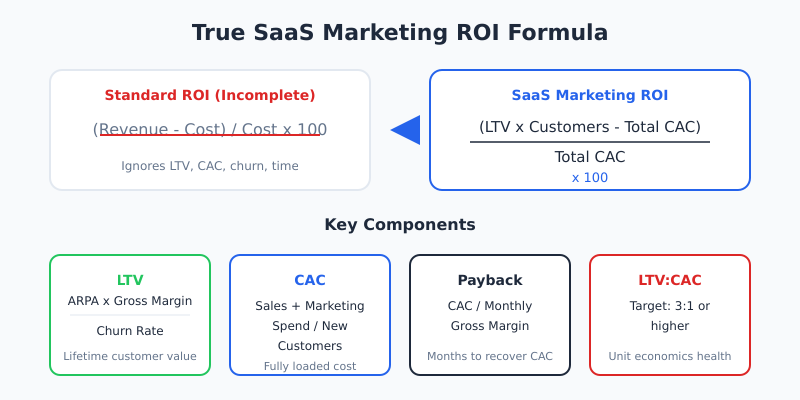
The Right Formula: SaaS Marketing ROI
For B2B SaaS, you need a formula that accounts for customer lifetime value, fully-loaded acquisition costs, and time. Here is what I recommend:
True Marketing ROI = (LTV x New Customers – Total Marketing Cost) / Total Marketing Cost x 100
This looks simple, but the devil is in the components. Let me break each one down.
Customer Lifetime Value (LTV)
LTV tells you the total gross profit a customer generates over their entire relationship with your company:
LTV = ARPA x Gross Margin % x Average Customer Lifetime
Where Average Customer Lifetime = 1 / Monthly Churn Rate.
For example, if your ARPA (Average Revenue Per Account) is $500/month, gross margin is 80%, and monthly churn is 2.78%, then:
LTV = $500 x 0.80 x (1/0.0278) = $500 x 0.80 x 36 = $14,400
Customer Acquisition Cost (CAC)
CAC must be fully loaded. This means including everything, not just ad spend:
- Marketing team salaries and benefits (proportional to channel)
- Software tools (CRM, marketing automation, analytics, SEO tools)
- Content production costs (writers, designers, video)
- Ad spend and distribution costs
- Agency fees
- Sales team costs attributable to marketing-sourced pipeline
CAC = Total Sales and Marketing Spend / New Customers Acquired
As David Skok of Matrix Partners notes, one of the most common mistakes in SaaS metrics is underloading CAC by excluding salaries, tools, or overhead. This makes your ROI look better than it actually is.
CAC Payback Period
Even when true ROI is positive, you need to know how long it takes to recover your acquisition investment:
CAC Payback = CAC / (ARPA x Gross Margin %)
A healthy B2B SaaS company targets a payback period under 18 months. Anything over 24 months is a warning sign, even if ROI is technically positive.
LTV:CAC Ratio
This is the single most important metric for evaluating marketing efficiency:
- Below 1:1 — You are losing money on every customer
- 1:1 to 3:1 — Marginally profitable or underinvesting in growth
- 3:1 to 5:1 — Healthy and sustainable
- Above 5:1 — Potentially underinvesting in growth (you could spend more)
The benchmark from Bain and Company suggests that best-in-class SaaS companies maintain an LTV:CAC ratio between 3:1 and 5:1 while keeping payback under 12 months.
Blended vs. Channel-Specific ROI
There are two ways to calculate SaaS marketing ROI, and you need both.
Blended ROI takes your total marketing investment across all channels and divides by total customers acquired. This gives you an overall picture of marketing efficiency, but it hides which channels are actually working.
Channel-specific ROI isolates each channel’s investment, attributed customers, and resulting LTV. This is harder to calculate because of attribution challenges, but it is essential for budget allocation.
Here is what channel-specific ROI typically looks like for a mid-market B2B SaaS company:
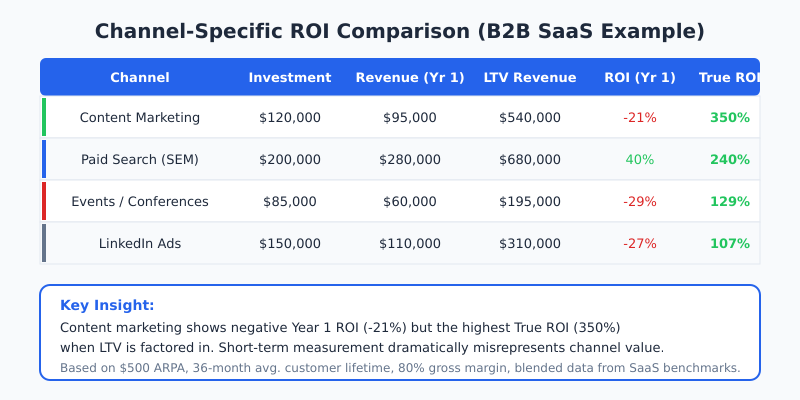
The pattern I see repeatedly is that content marketing and SEO look terrible on a 12-month horizon but dominate on a 3-year horizon. Meanwhile, paid channels show quick returns but often bring in customers with higher churn rates. This is why measuring both timeframes matters.
Worked Example 1: Content Marketing ROI
Let me walk through a complete calculation using realistic numbers from a B2B SaaS company with $500 ARPA.
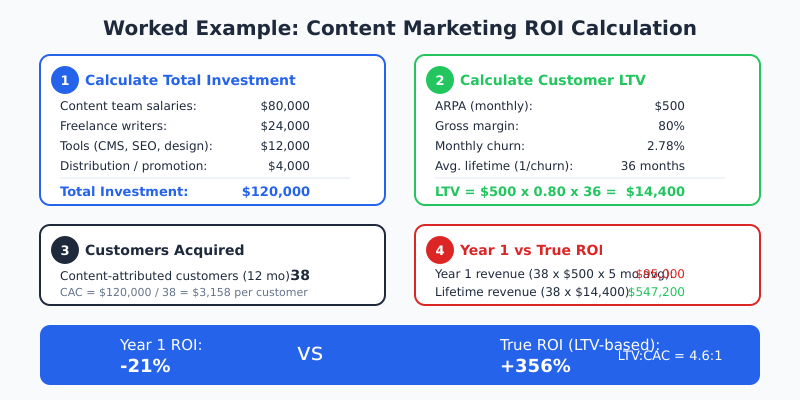
The Investment (Annual)
- Content team salary (1 FTE, allocated): $80,000
- Freelance writers: $24,000
- Tools (CMS, SEO software, design): $12,000
- Distribution and promotion: $4,000
- Total: $120,000
The Results
- Content-attributed new customers (12 months): 38
- CAC: $120,000 / 38 = $3,158
- Year 1 revenue (avg. 5 months of payments): $95,000
- Lifetime revenue per customer: $14,400
- Total lifetime revenue: 38 x $14,400 = $547,200
The ROI
Year 1 ROI: ($95,000 – $120,000) / $120,000 x 100 = -21%
True ROI (LTV-based): ($547,200 – $120,000) / $120,000 x 100 = +356%
LTV:CAC ratio: $14,400 / $3,158 = 4.6:1
If you only looked at Year 1 numbers, you would shut down this content program. The true ROI tells a completely different story.
Worked Example 2: Paid Search ROI
The Investment (Annual)
- Google Ads spend: $156,000
- Landing page development and testing: $18,000
- PPC management (agency): $24,000
- Analytics and tracking tools: $2,000
- Total: $200,000
The Results
- Paid search-attributed new customers: 50
- CAC: $200,000 / 50 = $4,000
- Year 1 revenue (avg. 7 months, faster conversion): $175,000
- Note: Paid search customers showed 15% higher annual churn (adjusted LTV: $10,800)
The ROI
Year 1 ROI: ($175,000 – $200,000) / $200,000 x 100 = -12.5%
True ROI (churn-adjusted): (50 x $10,800 – $200,000) / $200,000 x 100 = +170%
LTV:CAC ratio: $10,800 / $4,000 = 2.7:1
Paid search converts faster, so Year 1 looks better. But the higher churn rate means the true ROI and LTV:CAC ratio are significantly lower than content marketing. This does not mean you should stop paid search. It means you should understand what you are actually buying with each dollar.
Worked Example 3: Event Marketing ROI
The Investment (Per Major Conference)
- Booth and sponsorship: $35,000
- Travel and accommodation (4 team members): $12,000
- Promotional materials and swag: $8,000
- Pre/post event campaigns: $5,000
- Staff time (opportunity cost): $25,000
- Total: $85,000
The Results
- Qualified leads generated: 120
- Leads converted to customers (over 9 months): 12
- CAC: $85,000 / 12 = $7,083
- Event customers tend to be stickier (lower churn): adjusted LTV = $16,200
The ROI
Year 1 ROI: ($36,000 – $85,000) / $85,000 x 100 = -58%
True ROI: (12 x $16,200 – $85,000) / $85,000 x 100 = +129%
LTV:CAC ratio: $16,200 / $7,083 = 2.3:1
Events are the trickiest channel to measure because the sales cycle from event lead to closed deal is often 6-9 months. The Year 1 ROI is deeply negative, but the true ROI is positive. However, the LTV:CAC at 2.3:1 is below the 3:1 target, suggesting events should be a complement to other channels, not the primary growth engine.
Five Common Mistakes in SaaS Marketing ROI Calculation
1. Ignoring the Time Value of Money
A dollar of revenue three years from now is not worth a dollar today. If your company’s discount rate is 10%, that $14,400 LTV is actually worth about $11,800 in present value terms. Most SaaS companies skip this adjustment, which inflates true ROI by 15-25%. For planning purposes, I recommend applying at least a basic discount rate to any LTV-based ROI calculation.
2. Attribution Bias (Giving All Credit to Last Touch)
Last-touch attribution gives 100% of the credit to whatever the prospect clicked before converting. This systematically overvalues bottom-of-funnel tactics (paid search, retargeting) and undervalues top-of-funnel (content, brand, events). Research from Google’s Think with Google found that switching from last-click to data-driven attribution changed budget allocation by up to 30% for most advertisers. Multi-touch attribution, even a simple linear model, gives a more accurate picture.
3. Not Accounting for Churn in LTV
I once audited a SaaS company’s marketing ROI report that used a 48-month customer lifetime when their actual data showed a 24-month median. This doubled every channel’s apparent ROI. Always calculate LTV from your own churn data, segmented by acquisition channel if possible. As Patrick Campbell of ProfitWell (now Paddle) has emphasized: “LTV is the most important metric in SaaS, and also the one that gets calculated wrong most often. The compounding effect of even small churn miscalculations over a 3-5 year horizon is dramatic.”
4. Mixing Blended and Channel-Specific Numbers
Using blended CAC to evaluate individual channels is meaningless. Your blended CAC might be $3,500, but if organic search brings in customers at $800 and events at $7,000, the average tells you nothing useful. Always calculate channel-specific metrics when making allocation decisions.
5. Measuring Too Early
I have seen companies evaluate a content marketing investment after 90 days and conclude it failed. For B2B SaaS with a 4-6 month sales cycle, 90 days is barely enough time for leads to enter the pipeline, let alone convert. According to Content Marketing Institute’s B2B research, the most successful B2B content programs take 12-18 months to reach maturity. You need at least two full sales cycles of data before ROI calculations become meaningful.
A Practical Framework for Getting Started
If you are not currently tracking true marketing ROI, here is how I recommend starting:
Month 1: Establish your baseline metrics. Calculate your company-wide LTV, CAC, and churn rate. If you do not have these numbers, that is your first problem to solve. You cannot calculate ROI without them.
Month 2-3: Set up channel-level tracking. Implement UTM parameters consistently across all campaigns. Configure your CRM to track original lead source through to closed deal. Even basic first-touch attribution is better than no attribution.
Month 4-6: Calculate your first channel-specific ROI. Start with your highest-spend channel. Use the formula above with at least 6 months of conversion data. Compare Year 1 ROI with true (LTV-based) ROI.
Ongoing: Refine and expand. Add more channels, segment LTV by acquisition source, experiment with multi-touch attribution models, and start applying discount rates for time value.
The goal is not perfection. It is getting close enough to make better decisions than you are making today. A roughly right ROI calculation beats a precisely wrong one every time.
As Rand Fishkin, founder of SparkToro, has pointed out: “The obsession with perfectly attributable ROI leads marketers to only invest in what is easily measurable, which is a tiny fraction of what actually influences buying decisions.” The best approach is combining rigorous measurement with the intellectual honesty to acknowledge what the numbers cannot capture.
Frequently Asked Questions
What is a good marketing ROI for B2B SaaS?
A true (LTV-based) marketing ROI of 300-500% is considered healthy for B2B SaaS, which corresponds to an LTV:CAC ratio between 3:1 and 5:1. Year 1 ROI will typically be lower or even negative for channels with longer payback periods. The key benchmark is maintaining a CAC payback period under 18 months while keeping overall LTV:CAC above 3:1.
How do I calculate marketing ROI when I have multiple touchpoints?
Use a multi-touch attribution model rather than giving all credit to the first or last touch. Start with a simple linear model that distributes credit equally across all touchpoints in the buyer journey. As your data matures, move to a time-decay model (which gives more credit to touches closer to conversion) or a data-driven model. Even an imperfect multi-touch model produces better ROI calculations than single-touch attribution.
Should I use revenue or profit in my SaaS ROI calculation?
Use gross profit, not revenue. LTV should be calculated as ARPA multiplied by gross margin percentage multiplied by average customer lifetime. Using revenue instead of gross profit inflates your ROI by 15-30% depending on your margin structure. For most SaaS companies with 70-85% gross margins, the difference is significant enough to change budget allocation decisions.
How long should I wait before measuring marketing ROI for a new channel?
Wait at least two full sales cycles before calculating ROI for a new channel. For B2B SaaS with a 4-6 month average sales cycle, this means 8-12 months of data. For content marketing or SEO, extend that to 12-18 months because these channels have longer ramp-up periods. Measuring too early almost always makes new channels look worse than they actually are.
How do I account for brand marketing in ROI calculations?
Brand marketing is the hardest channel to attribute directly. Track indirect metrics like branded search volume growth, direct traffic trends, and win rates on deals where brand awareness was cited. Some companies use incrementality testing, running brand campaigns in select markets and comparing conversion rates against control markets. While you may not get precise ROI for brand, tracking these proxy metrics helps justify and calibrate brand investment over time.

Lukas Reinhardt
10+ years building analytics stacks for SaaS companies.
More about me →