Choosing the right marketing attribution tool can make or break your SaaS marketing budget. I’ve implemented attribution systems for multiple SaaS companies, and the difference between good and bad attribution is often millions in wasted ad spend.
The challenge? Most attribution tools are built for e-commerce or general marketing. SaaS businesses have unique needs — long sales cycles, multiple stakeholders, free trials, and recurring revenue. You need tools that understand these complexities.
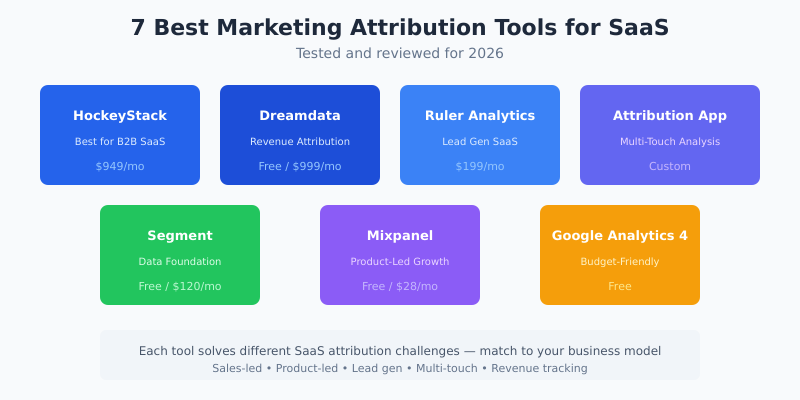
After testing dozens of platforms, I’ve identified the 7 best marketing attribution tools specifically suited for SaaS companies in 2026. Each solves a different problem, so I’ll help you match the right tool to your situation.
What Makes Attribution Different for SaaS?
Before diving into the tools, let’s understand why SaaS attribution is uniquely challenging:
- Long sales cycles — Enterprise deals take months, with dozens of touchpoints
- Multiple stakeholders — Buying committees mean tracking accounts, not just individuals
- Free trials and freemium — Conversions happen in stages, not single transactions
- Recurring revenue — LTV matters more than first purchase value
Generic attribution tools fail here because they’re optimized for single transactions. The tools below are built for — or excel at — SaaS-specific workflows.
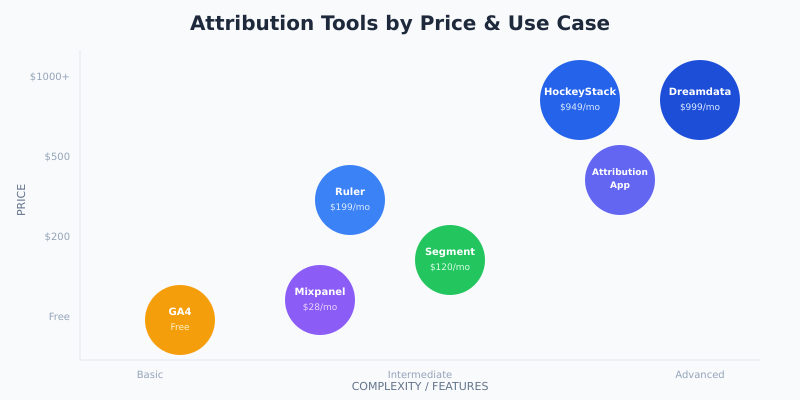
Quick Comparison Table
| Tool | Best For | Starting Price | Key Strength |
|---|---|---|---|
| HockeyStack | B2B SaaS | $949/mo | No-code, cookieless tracking |
| Dreamdata | Revenue attribution | Free / $999/mo | B2B revenue journey mapping |
| Ruler Analytics | Lead gen SaaS | $199/mo | Call & form tracking to revenue |
| Attribution App | Multi-touch analysis | Custom | Flexible attribution models |
| Segment | Data foundation | Free / Custom | CDP for unified tracking |
| Mixpanel | Product-led growth | Free / $28/mo | In-product behavior tracking |
| Google Analytics 4 | Budget-conscious | Free | Data-driven attribution |
1. HockeyStack — Best for B2B SaaS
HockeyStack has quickly become the go-to attribution platform for B2B SaaS companies. What sets it apart is the no-code approach — marketing teams can set up complex attribution without engineering resources.
Key Features
- Account-level journey tracking (critical for B2B)
- LinkedIn impression tracking at the account level
- Cookieless analytics for privacy compliance
- Customizable dashboards without code
Pricing
Starts at $949/month for 10 seats and 10,000 tracked users. Enterprise pricing available.
Verdict
If you’re a B2B SaaS with a sales team and need to track accounts (not just individuals) through long sales cycles, HockeyStack is the strongest option. The LinkedIn tracking alone justifies the price for companies investing heavily in LinkedIn ads.
2. Dreamdata — Best for Revenue Attribution
Dreamdata focuses specifically on B2B revenue attribution — connecting every marketing touchpoint to actual closed revenue in your CRM.
Key Features
- Automatic CRM integration (Salesforce, HubSpot)
- Content performance analytics
- Offline and online touchpoint integration
- Revenue-based attribution models
Pricing
Free tier available with limited features. Teams plan starts at $999/month. Custom enterprise pricing.
Verdict
Dreamdata excels at answering “which marketing activities actually drive revenue?” If your CEO or CFO wants attribution tied directly to closed deals (not just leads), this is your tool.
3. Ruler Analytics — Best for Lead Generation SaaS
Ruler Analytics specializes in connecting marketing touches to leads and revenue — particularly strong for SaaS companies that rely on demos, calls, and form submissions.
Key Features
- Call tracking with revenue attribution
- Form submission tracking
- Live chat integration
- Offline conversion tracking
Pricing
Starts at $199/month. Scales based on tracked visitors and features.
Verdict
Best for SaaS companies where leads come through calls, demos, or contact forms. The ability to track phone calls back to the original ad click is invaluable for sales-led SaaS.
4. Attribution App — Best for Multi-Touch Analysis
Attribution App offers comprehensive multi-touch attribution with flexible modeling options — ideal for SaaS marketers who want granular control over how credit is distributed.
Key Features
- Multiple attribution models (linear, time-decay, custom)
- CAC and LTV tracking
- Affiliate tracking included
- Centralized multi-channel dashboard
Pricing
Custom pricing based on requirements. Contact for quote.
Verdict
Choose Attribution App when you need sophisticated multi-touch models and want to track metrics like CAC payback period and LTV by channel. Particularly good for SaaS with affiliate programs.
5. Segment — Best Data Foundation for Attribution
Segment isn’t an attribution tool per se — it’s a Customer Data Platform (CDP) that makes accurate attribution possible. Many SaaS companies struggle with attribution because their data is fragmented. Segment fixes this.
Key Features
- Unified data collection across all touchpoints
- 400+ pre-built integrations
- Identity resolution across devices
- Clean data pipeline for any analytics tool
Pricing
Free tier (up to 1,000 visitors/month). Team plan starts at $120/month. Business tier is custom.
Verdict
If your attribution data is messy or fragmented, start with Segment. It won’t do attribution by itself, but it ensures whatever attribution tool you choose has clean, unified data to work with.
6. Mixpanel — Best for Product-Led Growth
Mixpanel shines for product-led SaaS companies where users convert through the product itself. It tracks not just acquisition but what users do after they sign up.
Key Features
- In-product behavior tracking
- Funnel and retention analysis
- User cohort analysis
- Marketing channel impact on activation
Pricing
Free tier up to 20M events. Growth plan starts at $28/month.
Verdict
For PLG SaaS companies, Mixpanel answers the critical question: “Which marketing channels bring users who actually activate and convert to paid?” It connects acquisition to product usage — something most attribution tools miss.
7. Google Analytics 4 — Best Free Option
Google Analytics 4 offers surprisingly capable attribution for free. Its data-driven attribution model uses machine learning to distribute credit across touchpoints.
Key Features
- Data-driven attribution (machine learning)
- Model comparison reports
- Conversion path analysis
- Google Ads integration
Pricing
Free. GA4 360 (enterprise) starts around $50,000/year.
Verdict
Start here if you’re budget-constrained or early-stage. GA4’s data-driven attribution is legitimately useful, especially if you’re running Google Ads. The limitation? It doesn’t connect to CRM revenue as smoothly as dedicated tools.
How to Choose the Right Tool
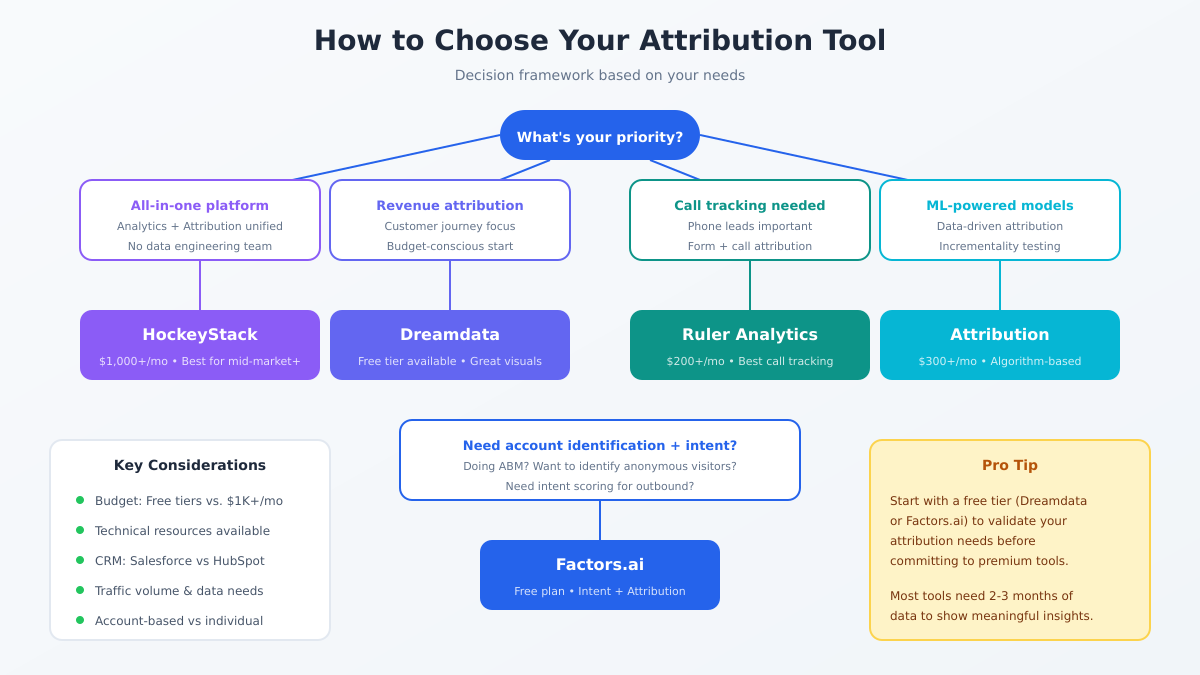
Match your tool to your business model:
- Sales-led B2B SaaS → HockeyStack or Dreamdata
- Lead generation focus → Ruler Analytics
- Product-led growth → Mixpanel
- Complex multi-touch needs → Attribution App
- Fragmented data problem → Start with Segment
- Early-stage / limited budget → Google Analytics 4
“Without data, you’re just another person with an opinion.”
— W. Edwards Deming
FAQ
What is marketing attribution software?
Marketing attribution software tracks and assigns credit to marketing touchpoints that lead to conversions. It helps you understand which channels, campaigns, and content actually drive results — so you can optimize budget allocation and improve ROI.
Why do SaaS companies need specialized attribution tools?
SaaS businesses have long sales cycles, multiple stakeholders, and recurring revenue. Generic attribution tools built for e-commerce can’t handle account-based tracking, free trial conversions, or LTV-based analysis. SaaS-focused tools are designed for these complexities.
What’s the difference between first-touch and last-touch attribution?
First-touch attribution gives 100% credit to the first interaction, while last-touch gives credit to the final touchpoint. Both are single-touch models with significant limitations — which is why most SaaS companies now use multi-touch attribution to get a complete picture.
Can I use Google Analytics 4 for SaaS attribution?
Yes, GA4 provides solid basic attribution with its data-driven model. However, it struggles with long B2B sales cycles, account-level tracking, and direct CRM revenue integration. It’s a good starting point but may need supplementing as you scale.
How much should I budget for attribution software?
Entry-level tools like Ruler Analytics start around $200/month. Mid-tier platforms like HockeyStack and Dreamdata run $950-1,000/month. Enterprise solutions with custom pricing can reach $2,000-5,000+/month. ROI typically exceeds cost if you’re spending significantly on marketing.
What’s the difference between attribution tools and CDPs?
Attribution tools analyze which touchpoints drive conversions. CDPs (like Segment) collect and unify customer data across sources. They’re complementary — CDPs provide clean data, attribution tools analyze it. Many companies use both together for best results.
Key Takeaways
The best attribution tool depends on your SaaS business model, not just your budget. Here’s my recommendation by stage:
- Early-stage — Start with GA4 (free) and clean data practices
- Growth stage — Add Mixpanel (PLG) or Ruler Analytics (sales-led)
- Scale stage — Invest in HockeyStack or Dreamdata for full revenue attribution
Don’t overcomplicate it early. Better to have accurate basic attribution than broken complex attribution. Start simple, prove ROI, then upgrade as your marketing spend justifies the investment.
For accurate attribution data, also ensure you’re using proper UTM parameters on all campaigns and consider server-side tracking to recover conversion data lost to ad blockers.

Leave a Reply