Should you credit the marketing channel that introduced a customer to your brand? Or the one that finally got them to convert? This is the core question behind first-touch vs last-touch attribution — and picking the wrong model can lead to serious budget misallocation.
I’ve helped dozens of marketing teams implement attribution tracking, and here’s what I’ve learned: both models have their place, but neither tells the complete story. Understanding when to use each — and when to move beyond them — is what separates data-driven marketers from those flying blind.
In this guide, I’ll break down how first-touch attribution and last-touch attribution work, when each model makes sense, and how to use them together for better marketing decisions.
What Is Attribution Modeling?
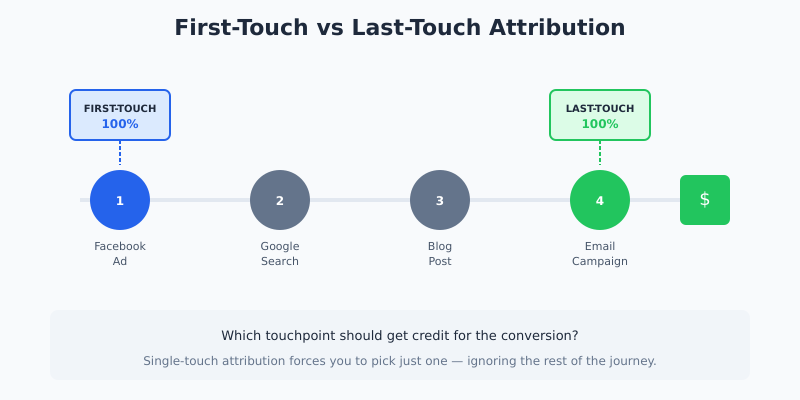
Attribution modeling is how you assign credit for conversions to different marketing touchpoints. When a customer interacts with multiple channels before buying — seeing an ad, clicking an email, searching on Google — attribution models determine which touchpoint gets credit for the sale.
There are two main categories:
- Single-touch models — Give 100% credit to one touchpoint (first-touch or last-touch)
- Multi-touch models — Distribute credit across multiple touchpoints
First-touch and last-touch are both single-touch models. They’re the simplest to implement and understand, which is why they remain popular despite their limitations.
First-Touch Attribution Explained
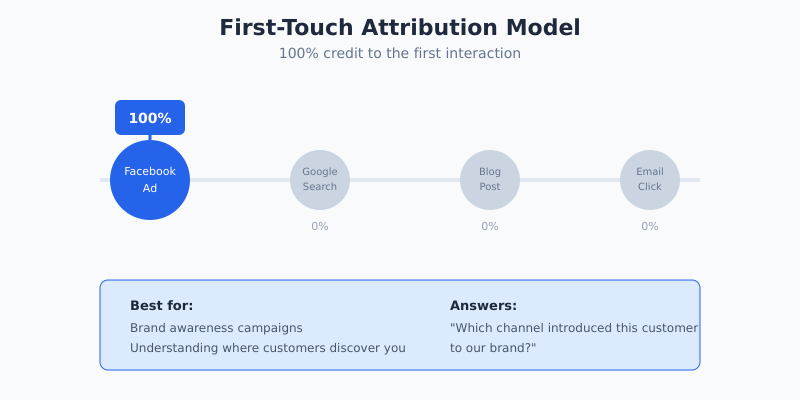
First-touch attribution (also called first-click attribution) gives 100% of the conversion credit to the first marketing interaction a customer has with your brand.
How It Works
Imagine this customer journey:
- Customer sees your Facebook ad → clicks through to your site
- Two days later, searches your brand on Google → visits again
- Week later, opens your email → makes a purchase
With first-touch attribution, Facebook gets 100% of the credit for this sale. Google and email get nothing — even though they played a role in the conversion.
When First-Touch Makes Sense
-
Brand awareness campaigns — Measuring which channels introduce new audiences to your brand -
Top-of-funnel optimization — Understanding where customers first discover you -
Demand generation — Evaluating which channels fill your pipeline -
Long sales cycles — When you need to identify what starts customer relationships
“Without data, you’re just another person with an opinion.”
— W. Edwards Deming
Last-Touch Attribution Explained
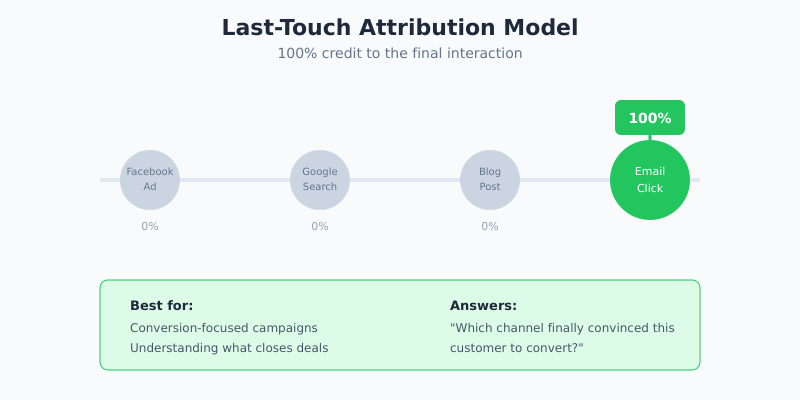
Last-touch attribution (also called last-click attribution) gives 100% of the conversion credit to the final marketing interaction before a customer converts.
How It Works
Using the same customer journey:
- Customer sees your Facebook ad → clicks through to your site
- Two days later, searches your brand on Google → visits again
- Week later, opens your email → makes a purchase
With last-touch attribution, email gets 100% of the credit. Facebook and Google are ignored completely.
When Last-Touch Makes Sense
-
Bottom-funnel campaigns — Measuring which channels close deals -
Short sales cycles — When customers convert quickly with few touchpoints -
Direct response marketing — Evaluating immediate conversion drivers -
Limited tracking resources — Simplest model to implement and maintain
Last-touch is the most commonly used attribution model. It’s the default in many analytics platforms, including Google Analytics 4’s standard reports.
First-Touch vs Last-Touch: Direct Comparison
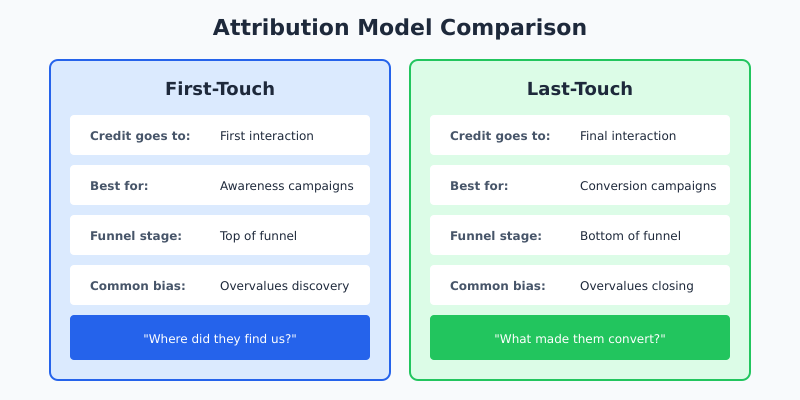
| Factor | First-Touch | Last-Touch |
|---|---|---|
| Credit goes to | First interaction | Final interaction |
| Best for measuring | Awareness & discovery | Conversion & closing |
| Funnel stage focus | Top of funnel | Bottom of funnel |
| Ignores | Closing channels | Discovery channels |
| Common bias | Overvalues awareness channels | Overvalues retargeting/email |
| Implementation | Simple | Simple (often default) |
The Problem With Single-Touch Attribution
Both first-touch and last-touch attribution share a fundamental flaw: they ignore the rest of the customer journey.
Limitations of Both Models
-
Incomplete picture — Real customer journeys involve multiple touchpoints -
Budget misallocation — May over-invest in one channel while underfunding others -
Middle touchpoints ignored — Nurturing campaigns get zero credit -
Direct traffic blindspot — Last-touch often credits “direct” when other channels drove awareness
Real-World Example
Consider a B2B SaaS company where the average customer journey looks like this:
- LinkedIn ad (awareness)
- Blog post via organic search (research)
- Webinar signup via email (nurturing)
- Demo request via retargeting ad (conversion)
First-touch says: “LinkedIn ads drive all revenue — double the budget!”
Last-touch says: “Retargeting drives all revenue — double that budget instead!”
Reality: All four touchpoints contributed. Cutting any one could break the funnel.
How to Use Both Models Together
Smart marketers don’t choose one model — they use both to answer different questions.
Practical Approach
- Use first-touch to evaluate brand awareness and demand generation campaigns
- Use last-touch to evaluate conversion and closing campaigns
- Compare both to find channels that introduce vs close customers
- Look for gaps — channels strong in first-touch but weak in last-touch need nurturing support
In Google Analytics 4
GA4 offers multiple attribution models in the Advertising workspace. You can compare first-click and last-click attribution in Model Comparison reports to see how credit shifts between channels.
When to Move Beyond Single-Touch
Single-touch attribution works for simple funnels. But if your business has:
- Sales cycles longer than a week
- Multiple marketing channels
- Both awareness and conversion campaigns
- High-value customers who research before buying
…then you should consider multi-touch attribution models like linear, time-decay, or data-driven attribution. These distribute credit across the entire customer journey, giving you a more accurate picture of marketing performance.
To implement any attribution model effectively, you’ll need a dedicated marketing attribution tool that can track touchpoints across channels and connect them to revenue.
FAQ
What is the difference between first-touch and last-touch attribution?
First-touch attribution gives 100% credit to the first marketing interaction, while last-touch gives 100% credit to the final interaction before conversion. First-touch measures what introduces customers to your brand; last-touch measures what closes them.
Which attribution model is better for my business?
Neither is universally better. Use first-touch to evaluate awareness campaigns and last-touch for conversion campaigns. Most businesses benefit from tracking both and comparing results to understand their full funnel performance.
Why is last-touch attribution so popular?
Last-touch is the default in most analytics platforms, easiest to implement, and directly tied to conversions. It answers “what made them buy now?” — a straightforward question with clear budget implications. However, this simplicity comes at the cost of ignoring earlier touchpoints.
Does Google Analytics 4 support first-touch attribution?
Yes. GA4’s Advertising workspace includes Model Comparison reports where you can compare first-click, last-click, and data-driven attribution. User acquisition reports also show first-touch data by default, while traffic acquisition shows session-level (last-touch) data.
What is the main problem with single-touch attribution?
Single-touch models ignore all but one touchpoint in the customer journey. This can lead to budget misallocation — overinvesting in channels that get credit while underfunding channels that actually contribute to conversions but don’t get measured.
Key Takeaways
First-touch and last-touch attribution answer different questions. The right choice depends on what you’re trying to measure:
- First-touch — “Which channels introduce new customers to our brand?”
- Last-touch — “Which channels close the deal and drive conversions?”
For most businesses, the best approach is using both models together. Compare first-touch and last-touch reports to understand your complete funnel — then consider moving to multi-touch attribution when you’re ready for deeper insights.
Start by running both reports in GA4. Look for channels where first-touch and last-touch performance differs significantly. These gaps reveal opportunities to optimize your marketing mix and allocate budget more effectively.
For accurate attribution data, make sure you’re using proper UTM parameters on all your campaigns so traffic sources are correctly identified in your analytics platform.

Leave a Reply