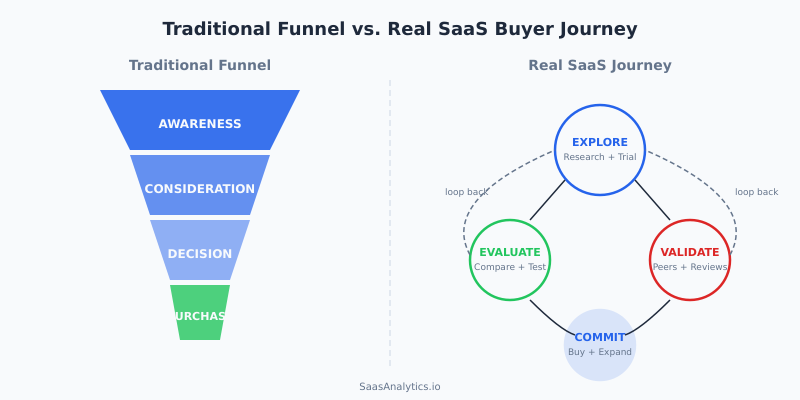
Every SaaS marketing team I’ve worked with over the past decade has built their strategy around the same model: a funnel. Top of funnel. Middle of funnel. Bottom of funnel. Awareness, consideration, decision. It’s clean. It’s logical. And it’s almost entirely wrong.
The traditional marketing funnel was designed for a world where buyers followed a predictable path — see an ad, visit a website, talk to sales, buy the product. That world doesn’t exist in B2B SaaS. Not anymore, and arguably not ever.
After analyzing marketing data for over 50 SaaS companies, I can tell you what the real buyer journey looks like: it’s messy, non-linear, and largely invisible to your analytics tools. If your measurement strategy is built on funnel stages, you’re optimizing for a fiction.
Here’s what actually happens — and how to measure it.
Why the Traditional TOFU/MOFU/BOFU Model Fails for SaaS
The classic marketing funnel assumes three things that rarely hold true in SaaS:
1. Buyers move in one direction. In reality, a prospect might sign up for a free trial (supposedly “bottom of funnel”), then go back to reading blog posts and comparing alternatives (supposedly “top of funnel”). A Forrester study found that B2B buyers engage in an average of 27 interactions before making a purchase — and those interactions don’t follow a neat downward path.
2. There’s a single buyer. SaaS purchases typically involve 6-10 decision makers according to Gartner research. Each person enters the “funnel” at a different point, consumes different content, and has different concerns. Your funnel is actually six funnels happening simultaneously — and they influence each other in ways that attribution tools can’t capture.
3. You can see the journey. Most of the SaaS buying process happens where your analytics tools have zero visibility. More on this shortly.
The funnel metaphor isn’t just oversimplified — it actively misleads. When you organize your team around TOFU/MOFU/BOFU, you end up with content teams chasing vanity metrics at the top, sales teams complaining about lead quality in the middle, and everyone arguing about attribution at the bottom.
What the Real SaaS Buyer Journey Looks Like
If the funnel is wrong, what’s the right model? Based on what I’ve seen across dozens of SaaS companies — from seed-stage startups to public companies — the buyer journey is better described as a series of overlapping loops.
The Explore Loop
Buyers don’t start at “awareness.” They start with a problem. They Google it, ask a colleague, or see someone mention a solution on LinkedIn. Then they explore — but not in a linear way. They might read three blog posts, check G2 reviews, listen to a podcast episode, and sign up for a free trial all within the same week. Or they might do nothing for three months and then come back.
HubSpot’s State of Marketing report found that 70% of B2B buyers consume 3-5 pieces of content before ever engaging with a sales rep. But “consume content” undersells what’s happening. They’re simultaneously evaluating, comparing, and validating — not moving neatly from one stage to the next.
The Evaluate Loop
SaaS evaluation doesn’t follow a linear path from “consideration” to “decision.” Buyers loop between trying the product, comparing alternatives, and going back to research. The rise of product-led growth has made this even more pronounced — when you can sign up for a free trial in 30 seconds, “evaluation” starts before most companies think the buyer has even entered their funnel.
Tomasz Tunguz, venture capitalist at Theory Ventures and a widely cited voice in SaaS, has noted: “The best SaaS companies don’t sell to customers — they let customers sell themselves. The buying process is increasingly self-directed, and the companies that win are the ones that make it easy to evaluate without friction.”
The Validate Loop
This is where the funnel model breaks down most completely. Before committing to a purchase — especially one that involves an annual contract — SaaS buyers validate their decision through channels that are almost entirely invisible to marketing analytics. They ask colleagues in Slack communities. They post in private LinkedIn groups. They look for real user experiences on Reddit. They ask their network for honest opinions.
This validation loop can send buyers back to exploration (“Wait, have you looked at [competitor]?”) or push them toward a decision. Either way, it’s happening outside your tracking.
Self-Service + Sales-Assist Hybrid
Modern SaaS buying rarely fits the old binary of “self-serve” or “sales-led.” Most mid-market and enterprise deals involve both. A buyer might self-serve through a free trial, hit a complexity wall, engage sales for a demo, go back to self-serve evaluation, then loop in procurement. The journey zigzags between self-directed and sales-assisted modes — sometimes multiple times in the same deal.
Reforge’s growth loops framework captures this better than any funnel diagram. Instead of a linear path, think of interconnected loops where the output of one cycle feeds the input of another. A happy customer tells a colleague (output), who then starts their own explore loop (input).
The Dark Funnel: What Your Analytics Can’t See
Here’s the uncomfortable truth that most marketing analytics vendors won’t tell you: the majority of the SaaS buyer journey happens in the dark.
The term “dark funnel” (popularized by Chris Walker at Refine Labs) refers to all the touchpoints that influence a buying decision but can’t be tracked by analytics tools. This includes:
- Private Slack and Discord communities where buyers ask for recommendations
- Podcast mentions that plant seeds months before a buyer ever visits your website
- Word-of-mouth conversations — the “my friend at another company uses this” effect
- Private social media messages where people share opinions about tools
- Conference hallway conversations and in-person peer recommendations
- Reddit and forum threads that buyers find through search but never click through from
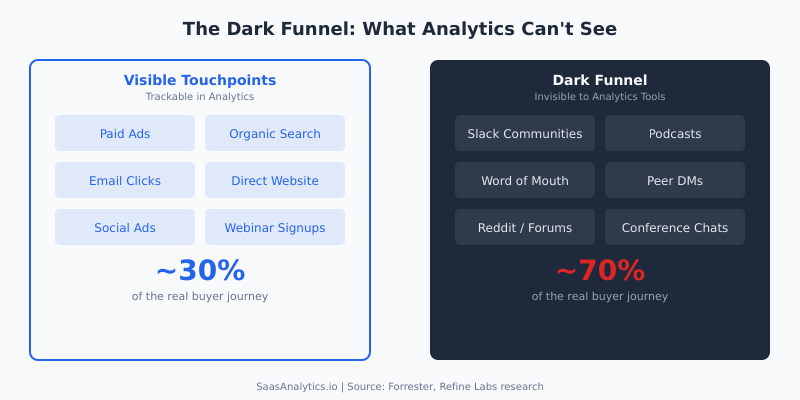
When Refine Labs analyzed self-reported attribution data across their client base, they found that over 60% of pipeline was influenced by channels that don’t show up in standard analytics. The buyer says “I heard about you on a podcast” or “A colleague recommended you,” but your CRM says “Direct” or “Organic Search” because that’s the first trackable touchpoint.
This isn’t a minor gap. It’s the majority of your actual marketing performance being invisible to the tools you use to make decisions. And when you can’t see where your revenue actually comes from, you make bad allocation decisions — over-investing in trackable channels (paid search, display ads) and under-investing in hard-to-measure channels (content, community, brand) that actually drive demand.
How to Measure a Non-Linear Journey
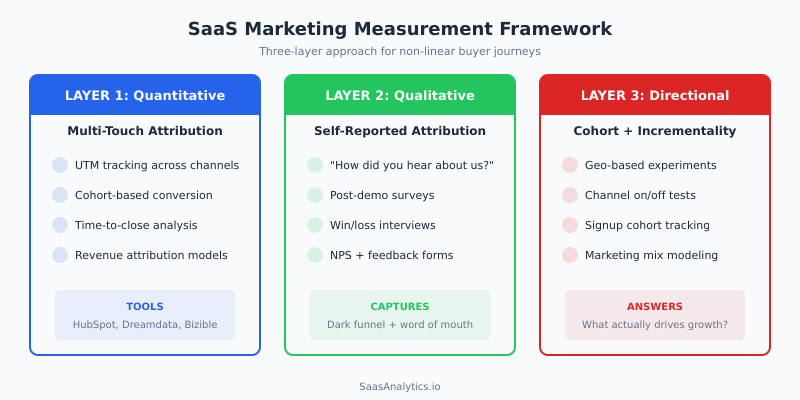
If the funnel is broken and most of the journey is invisible, how do you actually measure marketing performance? The answer isn’t to give up on measurement — it’s to use a layered approach that combines multiple signals instead of relying on any single model.
Layer 1: Multi-Touch Attribution (Quantitative)
Multi-touch attribution (MTA) still has value — just not as your single source of truth. MTA tools like HubSpot, Dreamdata, and Bizible can track the touchpoints they can see: website visits, email clicks, content downloads, ad impressions. Use this data for what it’s good at:
- Understanding which trackable channels contribute to pipeline
- Identifying content that correlates with faster deal velocity
- Spotting patterns in the paths that do show up in your data
But don’t pretend this data represents the full picture. It doesn’t. At best, MTA captures 30-40% of the real buyer journey. Treat it as one input, not the answer.
Layer 2: Self-Reported Attribution (Qualitative)
The simplest way to capture dark funnel influence is to ask. Add a “How did you first hear about us?” field to your signup, demo request, or onboarding flow. Make it a free-text field — not a dropdown. Dropdowns force buyers into categories that reflect your org chart, not their actual journey.
Kerry Cunningham, research director at 6sense, put it well: “Self-reported attribution is biased toward memorable moments, not first touches. But that bias is actually useful — it tells you which marketing activities create strong enough impressions to be remembered. And memorable impressions are what drive word-of-mouth.”
When you combine self-reported data with your MTA data, you start to see the gaps. If your MTA says 50% of revenue comes from paid search but your self-reported data says 10% of buyers first heard about you through ads, you know paid search is capturing existing demand — not creating it.
Layer 3: Cohort Analysis + Incrementality Testing (Directional)
The third layer answers the hardest question: what’s actually causing growth? Cohort analysis and incrementality testing move beyond correlation to establish directional causation.
Cohort analysis: Track groups of signups by time period and marketing activity. Did the cohort that signed up during your podcast campaign have different conversion rates, retention, or LTV than the cohort from the paid search push? This won’t give you perfect attribution, but it tells you whether specific activities correlate with better business outcomes.
Incrementality testing: Turn channels on and off in controlled experiments. Pause paid social in one region for a month. Stop publishing content for a quarter (please don’t actually do this). The gap between your baseline and the “off” period tells you the incremental impact of that channel.
Reforge recommends combining these approaches into what they call a “triangulation” model — using multiple imperfect signals to converge on a more accurate picture than any single model could provide.
A Practical Framework for SaaS Marketing Measurement
Here’s the framework I recommend after working with dozens of SaaS marketing teams. It’s not perfect — no measurement framework is — but it accounts for the reality of non-linear, partially invisible buyer journeys.
Step 1: Separate Demand Creation from Demand Capture
Most SaaS marketing teams conflate creating demand with capturing it. Paid search captures existing demand — someone already searching for your category. Podcasts, content, and community create demand — planting seeds that grow into future pipeline.
Track these separately. Use different metrics for each:
| Demand Creation Metrics | Demand Capture Metrics |
|---|---|
| Brand search volume growth | Conversion rates by channel |
| Direct traffic trends | Cost per qualified opportunity |
| Self-reported attribution themes | Pipeline velocity |
| Community engagement growth | CAC by acquisition path |
| Share of voice in category | Win rates by source |
Step 2: Build a Blended Attribution Model
Weight your attribution using a combination of all three layers:
- 40% weight to multi-touch attribution data (what you can track)
- 35% weight to self-reported attribution (what buyers tell you)
- 25% weight to incrementality signals (what experiments show)
These weights aren’t scientific — adjust them based on your confidence in each data source. The point is that no single model gets more than half the weight.
Step 3: Track Leading Indicators, Not Just Lagging Ones
Pipeline and revenue are lagging indicators — they tell you what happened 3-12 months ago. For SaaS companies with longer sales cycles, you need leading indicators that predict future pipeline:
- Branded search volume — is more of your market actively looking for you?
- Direct traffic growth — are more people typing your URL directly?
- Self-reported attribution quality — are responses shifting from “Google search” to “colleague recommended” or “heard you on a podcast”?
- Engagement depth — are visitors consuming more content per session?
- Community mentions — are you being recommended in spaces you don’t control?
Step 4: Review and Recalibrate Monthly
Run a monthly “measurement review” where you compare signals across all three layers. Look for conflicts — if your MTA data disagrees with your self-reported data, investigate why. Look for convergence — if all three layers point to the same channel as a growth driver, you can invest with higher confidence.
The goal isn’t perfect measurement. It’s better decision-making. A framework that’s directionally right across multiple signals beats a framework that’s precisely wrong from a single source.
The Bottom Line: Stop Optimizing Funnels, Start Understanding Journeys
The SaaS marketing funnel isn’t a funnel. It’s a web of loops, dark touchpoints, and non-linear paths that defies the neat stages we’ve built our teams and tools around. Accepting this reality isn’t defeatist — it’s the first step toward actually understanding how your marketing creates revenue.
The companies getting this right — Slack, Notion, Datadog, Figma — didn’t win by perfecting their funnel. They won by creating products and content worth talking about, building communities around their categories, and measuring their marketing with enough nuance to invest in what works even when it’s hard to track.
Your analytics tools will never show you the full picture. That’s okay. Use the framework above to combine what you can measure with what buyers tell you and what experiments reveal. You’ll make better decisions than the team next door that’s still arguing about whether a blog post was TOFU or MOFU.
Because the funnel was never real. The journey is.

Lukas Reinhardt
10+ years building analytics stacks for SaaS companies.
More about me →